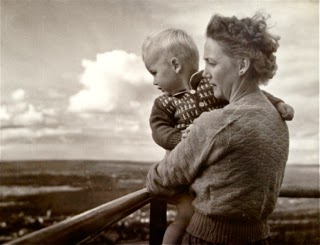
Tuesday, 7 February 2012

Mum

I spoke to my mum in Sweden today.

For newcomers to this blog and for those who don't know me, you can read an earlier post about mum hereShe is 90, will be 91 in March. (Yes, I know that makes me old but to my defence, she had me quite late in her life!) Mum suffers from Alzheimer's and has been living in a dementure home for the last couple of years.


She is very fit and mobile for her age, it's her memory that's failing her. But – she still remembers a lot. Somehow, I get a feeling that everything is there, but she doesn't always manage to 'get' to it.
If I want to tell her something about someone, I have to take one thing at the time and make sure that sinks in, before attempting the next 'thread'. If we are lucky, she remembers the first thing which then leads to the next. Other days, it's completely blank. Then there are times when she remembers something very far and distant which I can't recall myself!

And – she sometimes gets down and depressed. That's when she hallucinates and gets totally confused. Nothing can cheer her up then. She doesn't want to leave her own little 'mini-flat', within the home. She just wants to be on her own. I don't blame her. Just because you live in a 'home' doesn't mean you want to socialise every day...

However, today was a good day. She was happy and told me she had been dancing to a live band which visits regularly. Yes, it is a good care home, with loving and caring staff. One member of staff sometimes brings her two dogs and my animal-loving mother is in seventh heaven. They come into her room and sleep on her bed or lie on her lap. The dogs, that is – not the staff.

Talking of heaven... Mum asked me, whilst enjoying my YouTube clip of Fred Astaire (from my Mac in England to her phone in Sweden):
"Do you think I get to dance when I'm in heaven?" I assured her she would.
"Yes, she said. I will dance once I'm there. And sing: 'Heaven... I'm in Heaven... la-la-la-la...when we're out together, dancing cheek to cheek!"
She has never been taught English but as she puts it – she learnt her English from watching films at the cinema when younger.

I hope she stays happy for a long time to come.


Thursday, 19 January 2012

Yummie Yule Traditions


They were lying there, blatantly open for anyone to see, in the glass counter at our local baker's.

During the first day of my recent Christmas holiday in Arvika, Sweden, I had popped in to get a quick something for our coffee. I hadn't expected this, though. I hadn't expected semlor in December!


"Oh but they are made with saffron" said the lady behind the counter. As if that would alleviate the shock. I kindly turned down the offer, paid for my four lussekatter and left the shop, pondering about traditions.

I have always maintained that it is morally wrong (I exaggerate now, for effect) to provide semlor for public consumption before the time they are meant to be eaten. Just as it would be wrong to throw a crayfish party at Easter, boiled and painted eggs at Midsummer or sing Helan Går on New Year's Eve
I mean – why can't people just respect traditions? They are there for a reason, you know.
We buy flat screen TVs, Chanel No5 perfumes and X-boxes to celebrate the birth of Jesus, right? Some of us go as far as Boxing Day Sales, to please the Lord. We eat till we drop and stay merry and gay throughout the festive Season, just to celebrate that a child was born in Betlehem.

But as I was strolling along with my newly aquired lussekatter in the centre of Arvika, filled with increasingly desperate shoppers, it dawned on me just how narrow-minded I had been.
If we really like something – whatever it might be and for whatever reason – why shouldn't we be able to enjoy it all year round? Life is too short for avoidances and Bah Humbugs. Like Scrooge on Christmas Day, I changed my mind. I came to the conclusion that whoever felt like stuffing themselves with semlor on Christmas Eve had the perfect right to do so.

For me, Christmas Eve was spent in a somewhat updated family constellation this year. There were Swedish, English, French and Arabic influences. Young and old, men and women. Some were meat-eaters, some ate fish, but not meat. Some were vegetarians, some didn't eat pork. Various cultures, religions – and 'non religions' – were represented amongst our little family gathering. This might sound like a brewing Bergmanesque drama, waiting to happen, but... no. Far from it.

We cherry-picked bits from our varied and unorthodox smörgåsbord, we laughed a lot and had a great Christmas Eve. There was a good mix of languages with not that much lost in translation, even though I must admit, it is never easy to explain to non-Swedes just why a whole nation watches Disney at 3pm, year in, year out. "Look. In the UK, there is the Queen's Speech. We have Kalle Anka. Get over it."

Anyway. The moral of this story is: "To everyone what they want, whenever they want it."
Because they are probably worth it and it really doesn't matter why they want it – as long as it is for a good cause.

And no, there were no semlor on our Christmas table. But... you know what? I might just give it a go, next Christmas!

Sunday, 15 January 2012

If Lars Norén had done IKEA

Whenever I walk around an IKEA shop in the UK, I find it amusing that I understand what the product names really mean, whereas the English speaking IKEA staff probably don't. (Or maybe they have done a course – I don't know.) I have always wondered what it would be like if the names weren't so... perfect. And nice. Therefore, I made my own, cynic list of products.


Swedes will understand this one – I hope. If you're not Swedish or if you're Swedish but never heard of  Lars Norén , I can tell you he's a Swedish playwright, known for his realistic, incredibly gritty and black family dramas.


Ash tray – NICOTINE
Bar stool – WOBBLE
Bathroom scales – ANOREXIA
Bed sofa – DIVORCE
Bib – DRIBBLE
Bread knife – PLASTER
CD shelf – PIRATE
Ceiling mirror – PERVY
Cocktail glass – TIPSY
Dining table – DARFUR
Door mat – PISS-OFF
Foldable table – PINCH
Guest towel – SHOW-OFF
Handmade carpet – SADDAM
Kitchen hook – BROILER
Laminate floor – FRACTURE
Magnifying glass – ACNE
Oven cloth – ASBESTOS
Pillow case – SNORE
Plastic bucket – VOMIT
Plate – CALORIE
Scented candle – CANNABIS
Sheep skin mat – HALAL
Shower curtain – PSYCHO
Spring mattress – OUCH
Sunbed – MELANOM
Swivel armchair – DIZZY
Table fan – MENOPAUSE
Toilet mat – DRIP-DROP

I'm sure you can add a few?

Thursday, 17 November 2011

Cab Poetry 3

To any newcomers to my blog:
What you are about to read is another post in my series "Cab Poetry". As an honorary London black cabbie (true!) and first ever punter of the excellent @tweetalondoncab I collect random, authentical cabbie tweets and arrange them artistically in... well, poems. Enjoy.


"I'm at Padders. I don't know why.

At oxo on me own

Playing EC5 lottery

That was quick hot a hail

Grv hse buzzin

Did 2 min at grov & got a city

Need a wee in ec3

On me lonesome at smiths

Work mcliver

Havin a go at the grosvenor

Off zuma to The liver

padds moving ok

Sloane Square fully cabbed out.

Bollocks. Hilton metropole to boscobel road. I surrender

Oook me! 15 mins in pk n off to a qqqqq peeps on the 3

Kettle's on at the feeder park

I am at abacus in front of the touts

Bollox tooting bec didn't wanna finish yet

There may be a pot of gold at the end of even the shortest shit coloured rainbow"

Tuesday, 25 October 2011

There's Reality TV and then there's Reality TV


I had the privilege to attend an excellent event this week, at the Frontline Club in London – an inspiring meeting place, not just for journalists but for everyone who takes an interest in journalism and current affairs. And I do.

There are so many stories to tell out there, so many atrocities which need to be revealed, that normal news broadcasting time just isn't enough. Typically, news programmes are filled with the hottest topics, news items that make the headline that particular day. Pieces get dropped from the news belt when more newsworthy stories get wired in. Or tweeted in, even.

This is why I love Unreported World. This is the programme which picks up the stories that never get a mention in the daily news shows. This is the programme which gives a voice to Ugandan babies, dying at an early age from a terrible disease that can be cured – just because their parents cannot afford to travel to the doctor who can provide the operation. This is the programme which makes you physically share the fear amongst Syrian activists, protesting against the regime. The programme exploring how South Africa, seventeen years after being freed from apartheid, might not be as equal as we 'd like it to be.

I could go on. So many films, so many brilliant reporters risking their own lives to make these unique films.
Not just reporters, by the way. As was pointed out last night, these films are team efforts. Behind the scenes are camera crews, producers and not least – fixers in each country. All taking great risks to make sure these stories are being told. To us. You and me.
Something I very much appreciate about the work these teams do, is the fact that they go the extra mile to make sure their local contacts and fixers won't suffer from repercussions once the team has left and the film has been broadcast . There's a lot we don't see. In the report from Syria, I learnt there were constant change of hotels, change of cars, clothes and a general 'moving around', to avoid identification of the crew and fixers. Also, the faces of protestors were blurred throughout. Brilliant. Thoughtful. Shows how much care goes into the production.

It was great to be able to talk to the reporters at the event, pick their brains and hear their background stories about what went into each film.
You can watch the films on their website and now also on 4oD – around the world. No geographical restrictions anymore.

I am looking forward to seeing the next film this Friday, about Nigeria's millionaire preachers. I watched a clip at the event and it is definitely worth watching. Directly after Channel 4 News, on Fridays. Couldn't be better.

Sunday, 16 October 2011

Lost in Translation


This comparison will only make sense if you know English and Swedish. My (Swedish) daughter told me about a text having been translated into various languages, on a falafel mix package she had bought. One of the translations was Swedish. Well, sort of.
Here you go:

ENGLISH

Ingredients: chick pea, beans, salt, special Meshwar spices
Directions:
-Mix each 1 sacks with 125 ml (half glass) of warm water
And stir well to be tenacious mixture
-Use the mold to shaping the Falafel pieces
-Fry Falafel pieces in hot vegetable oil
-Introduce with vetegables, tahina and salads

SWEDISH

Ingredients: kyckling/ärt, bönor, salt, särskilda Meshwar kryddor
Riktningar:
-Blanda varje 1 säckar med 125 ml (halvt glas) i varmt vatten och rör väl vara ihärdiga blandning
-Använda mögel till att forma den falafel bitar
-Jugoslavien flafel bitar i varma grönsaker olja
-Införa med grönsaker, tahina och sallader


I was especially puzzled about the word 'fry' becoming 'Yugoslavia'. Soon realised...
F.R.Y. = 'Former Republic of Yugoslavia'. Sigh.

Sunday, 14 August 2011

Unsocial Media?


Last week, the MP for Corby and Northamptonshire, Louise Mensch, said blackouts of Twitter and Facebook would have helped the police during the recent riots. As rumours spread fast via social media, the police wasted valuable time responding to false alarms. Louise Mensch also said BBMs (BlackBerry Messenger), with which help riots and looting were being coordinated, could have been dealt with by carrying out "maintenance" for a short period of time. Although few argued she was wrong in assuming social media was used in such a way, she faced a lot of criticism for suggesting a shut down.

I also disagree with Louise Mensch. I can see where she is coming from, but at the end of the day, Twitter, Facebook and the rest of it are just tools. A way of communicating, like... you know, talking. Free speech, free use of social media is part of our rights but it also comes with responsabilities. People will use it both for good and bad. In my view, bans or shutdowns, like the ones we saw during the Arab Spring, must be avoided.

Personally, I made good use of Twitter during the riots. And no, not for rioting. On 'that' Monday evening, my non tweeting daughter had to get from work in North London back to her home in Hackney. I had been observing the escalating violence and rioting during the afternoon, via twitter and the news. She hadn't. I knew she hadn't, as she was busy working that day. Obviously, she had heard things were happening but was not aware of the way the riots had spread.

The more I heard about things kicking off in Hackney, the more I felt I had to warn her. I texted her and she texted me back and promised she would look out for my texts. I was following the #hackney, #londonfields and the #dalston hashtags on twitter as well as the #riots and the #london ones. I saw a lot of people warning about 'bike mugging', especially in London Fields. I sent a her another SMS. "Make sure your mobile is charged before leaving work and - hold on to it!" She replied: "Oh, I'm heading to South London first, to pick up my NEW (!) bike after work, then I'll be cycling back to Hackney and London Fields."

Yeah right. "Recalculating"...

Her boyfriend was going to join her from (his) work in South London - on his bike. However, once they heard from me how the riots had spread and developed into the very area where they lived, they decided to leave their bikes in South London and take the tube to Dalston Junction, then walk. We kept in touch via SMS during their journey back. Via twitter, I could keep up with the movements of the rioting mob and make sure they knew which areas to avoid. Note - I don't even live in London, I live in Swindon... It was with a great sigh of relief I finally received a text saying they were now back home. Safe. Well, at least they were indoors.

This is just one example of how social media was put to good use during the riots. I am sure lots of people did the same thing as we did, to protect loved ones. As we now all know, communities later made incredibly good use of social media in the clean up process. Not least @Riotcleanup did a brilliant job organising help across London for both cleaning and general support.

I think a shutdown of social media would not just be undesirable. It would be dangerous.
What do you think?

Saturday, 13 August 2011

Should we have predicted a riot?


There is no easy fix and no easy answer as to why the recent riots in England kicked off the way they did.

The riots brought out the worst - and the best - in people. What is it, that makes an individual give up his or her social responsibility and respect for others? Why did people throw away all their moral scruples for a pair of designer trainers, a box of mobile phones or even a pack of mineral water?
Where lies the excitement in throwing missiles at police cars, smashing a shop window and setting the corner shop alight? The very same corner shop where you buy your fags & mags and chat with the owner?

Part of it is down to group mentality, like fish in a fish shoal. The dictionary says:
"Swarm behaviour, or swarming: A collective behaviour exhibited by animals of similar size which aggregate together, perhaps milling about the same spot or perhaps moving en masse or migrating in some direction."

That pretty much says it all. But at what point did people - of all races, sexes, ages and walks of life - let the swarm behaviour take over their social instincts and morals?

Sadly, the debate so far has been very polarised. You either blame the society, culture and/or the government and point at the underlying reasons as to why it happened. Or you blame the individual, their parents and ask for tougher sentences, rubber bullets and longer prison sentences. Adapt the former view and you are classed as a left-wing, liberal idealist with no sense of reality. Adapt the latter and you are a right-wing, conservative traditionalist who believes discipline and deterrence are the only ways forward. I believe there is no black and white analysis to be had. It is, indeed, complicated.

As much as I condemn the appalling actions committed by these individuals, I still believe everyone is a product of his or her society. We all started off as newborn babies, but for some, the environment was not as socially nourishing as it was for others. For some, the world consisted of things. Comforting things. 'Dummy' replacements. Toys. Bags of crisps and Play station. If all you have ever been offered by your parents are things, rather than their time and love, then 'things' will become important to you.
If you have never had a book read to you, never been taken on a visit to the museum, been offered help to explain that algebra homework or had a chance to go on holidays where you meet other people, experience different cultures - then the perception of the world is bound to be different. So yes, I do think a lot of the riot behavior stems from inequality. It is easy to blame the parents but - what were these parents offered by their parents? Also, it has to be said, the society we live in now is not the same as it was, say 30 years ago. On the other hand, not all the rioters were children. In fact, not everyone was even rioting as such. It all started off as a reaction to the shooting in Tottenham, but - somehow, that feels a long time ago now.

A question was raised during the recent BBC Question Time: "Why is it, these riots never happen in countries like Sweden and Norway?" Someone replied: "Equality. It's down to equality."

I feel that really IS one of the fundamental reasons. When part of a country's population has been bereft of the possibility to achieve what they want because of social and economic inequality, there will be consequences. Instead of aspiring to become something, to get out of life what they want, people will become fed up. Fuelled with low self esteem, bitterness and anger with just about everything and everyone, these individuals collectively make a dangerous mix.

If an opportunity arises to get that pair of designer jeans which has just suddenly become available in front of your eyes - with no police to catch you - then you grab them. In fact, you might as well grab the whole rack.

As much as I find the looting morally wrong, I can sort of understand the reasons for it. What I can't quite apprehend is the lack of respect for one's own community. How can you deliberately rob and set fire to someone's corner shop, risking the lives of everyone living in the flats above? If someone was angry with society as a whole, I would expect him or her to attack Westminster, not Hackney. That puzzles me. I can only assume it was that "swarm behaviour" taking over. No 'inner' moral barrier to stop , to say "Hang on, this is wrong."

I do not want to blow my own Swedish trumpet too much and we are far from perfect in Sweden either, but having lived in both countries I do feel there is a difference. The relevance in bringing the Swedish model up is the fact that we have yet to experience something like this in Sweden and I doubt very much we ever will. Undoubtedly, there is still a lot to be done to achieve increased equality in Sweden, but I dare say we have come a lot further than the UK in this respect - with regards to both class and gender.
We don't do titles. Uniforms, suits & ties are not that important. We have a relatively well working social 'rescue net' which catches vulnerable individuals before it's too late. Not always, mind you - but most of the time. We say parents - not 'mums'. A 'page 3' in our few tabloids would be stopped by our discrimination laws before it got a chance to cause public outrage. I could go on.

I firmly believe that the likelihood for riots to happen is relative to the degree of equality a country can show for herself. It takes generations to change and is sadly not a quick fix.

If nothing else, the riots made a lot of people stop and think. We opened up and shared information to support each other. It made communities stick together and stand strong, offer amazing help and support, building new bonds which, I am sure, will last forever. There are so many aspects to discuss, too many for one single blog post. I feel another one coming on...
One which will talk about the role of Social Media in the riots.

Saturday, 25 June 2011

Dill galore in Wallander land


Nationalism. I don't like that word. Too many negative connotations throughout history, too much egoism, greed and intolerance. And still, when it comes to Midsummer, I feel very Swedish.

I feel proud of our Swedish Midsummer traditions, the way we celebrate the height of the summer, the light, the long summer nights. I mean... can you blame us? After what seems like an eternal, dark, cold winter with short days and depressing darkness, Summer comes as a welcome relief, a breathing space. Laid back Swedes let their hair down and enjoy each other's company in a feast celebrating this short period of light. Ok, this solstice indulgence is very much alcohol induced, I grant you. However, that is probably what it takes for us Swedes to show our inner emotions. Italians we are not.

Anyway. What I really wanted to say is that I think we become more nationalistically inclined the longer we stay away from our native country. I was never that bothered about celebrating Midsummer when I lived in Sweden. But now, after soon 13 years away from what I still call home, I'm making the most of this weekend. My Swedish flag is on the table, it's pickled herring if I can find it, salmon, prawns and lots of dill.

Saturday, 21 May 2011

Du pain, du vin, du Pork Pie.


I went to our local shop the other day and spotted a Goat's cheese, wrapped in a big label, saying "reduced"! Win win - it ended up in my shopping basket...

It enjoyed a few days in the fridge - I don't eat Goat's cheese every day, you know! Anyway, a few days ago I removed the dark blue wrapping and... The cheese had gone all brown!! Damn.
Ok, I know it had been reduced but still - it wasn't that long ago I bought it. I cut a piece to see what it looked like within.

It was a Pork Pie.

Monday, 16 May 2011

There is more to twitter than breakfast cereals


If you're on Twitter, you know what I mean:
The constant: "Oh yes, Twitter. That's when you talk about what you had for breakfast and chat to celebs all day, isn't it? Not my cup of tea, sorry."

And even if you're not on Twitter, I think I need to tell you a little incredible story. Are you sitting comfortably? Then I'll begin:

The background is also part of the serendipity:
My home town of Arvika in Sweden flooded badly in 2000. During a visit, I became so impressed by the temporary flood barrier which ended up saving the whole town, I felt the need to thank the inventor personally. So I did. Found his name in a local paper, emailed and told him he really ought to introduce this barrier in the UK - with all the flooding we had here, in 2000. He said: "Why don't you do it?"

So, in January 2001, out of pure belief in something that I'd seen working, I abandoned my teaching career and found myself working as the UK Manager for Geodesign Barriers Ltd. Although my initial suggestion was just to help him translate a leaflet...
We provide temporary flood barriers to... anyone who wants them, really. We protect anything from garden sheds to big cities and anything in between, whether before - or during - a flood. Think: instead of sandbag walls or instead of 'doing nothing'. A Meccano looking steel skeleton with plastic membrane draped over it. Or, as it's often described: "The Scandinavian, IKEA-style, flat-packed solution." (No Allen key required.) Customers range from the Environment Agency, Local Authorities, Power companies etc. You might remember Walham, Gloucester, 2007?

Anyway. You get the picture. And here goes the amazing story:

Once upon a time, a Swedish Geodesign Barrier boss just happened to be in the US for a "Flood Fighting Fair" in Albuqurque, when the great Mississippi River started to flood, due to heavy rainfall and snow melt. As he already had some barrier stocked in America, he saw the possibility to help - free of cost, of course. However, having tried - in vain - to deploy the barrier somewhere in the Memphis area, he was now struggling to find a suitable place for it in the Louisiana district. So - come Saturday evening, I had a phone call:
"Britt, maybe you could try to find me somewhere, via... that Twitter thing?", said this non-tweeting Swede.

Of course I could. After some initial, pleading tweets to all my followers and specifically to the journalist types, emergency disaster contacts, various news agencies etc - things started to move, in that viral way that things tend to move on Twitter. Result! A few hours (!) later, my boss received a call from emergency contacts in Franklin, Louisiana. They had found the perfect place for our barrier.

And so it happened, that a soon-to-be flood stricken town in the deepest bayoo of swampy Louisiana received a temporary flood barrier. A flood barrier which now will protect them against the predicted flood water - ETA on Thursday, at the moment of writing this blog post. You might have heard on the news that the Morganza Spillway has been opened to avoid flooding of the most vulnerable areas of the Mississippi delta. Tough decision, as consequently, other places will be flooded. Franklin is one of them.

I must add that this would not have happened, had it not been for the incredibly speedy help of lovely Donna and Leesa at @info4disasters . They were the ones who ultimately put my boss in touch with local emergency staff in Franklin. Here is the press release they gave out:


Amazing what you can do from the comfort of your armchair on a Saturday night - instead of watching the Eurovision Song Contest.

The top two pictures shows the deployment.

Sunday, 24 April 2011

Lesson learnt


"Can I help you wipe the board please, Miss?" I was impressed by the kindness and the politeness of this girl, in her early teens. It was one of my first days as a teacher in the UK, where I had taken on the challenge of teaching French to a great mix of 30 or so English pupils, at a Community College. It hadn't been easy to find a teaching job and as a Swede, I was lucky to having been accepted for this post. The fact that I had been happily working as a teacher for 13 years in Sweden (see picture) didn't mean much to potential employers, as they valued the knowledge of the national curriculum more than they did previous experiences. Hearing that previous English, experienced teachers had ended up with nervous breakdowns after having taught this particular class didn't do much for my self esteem either. But hey ho - I could do it better!

"Why, of course you can help me. How kind!" It wasn't until the following day I realised that this generous gesture of support was nothing but an attempt to get golden stars in her book.
In fact, in the coming weeks, fights would be fought at the end of each lesson as to who would be the lucky, chosen one. "She did it last week, Miss!","Oh Miss - that's not fair!"
I ended up doing it myself. Stop "Missing" me around! I told the class that if they weren't helping me because they really wanted to, I might as well wipe that board myself - as I had been doing for 13 years back in Sweden. There, I'd said it. I'm not sure this was in line with the national curriculum or the staff policy, but my gut feeling told me that morally, this was the right thing to do.

I would like to be able to say I loved being a teacher in England. But the truth is - I pretty much hated it. Back in Sweden, I truly enjoyed the good contact I had with my pupils. Yes, there were discipline problems at times there too, but at least they respected me for who I was - not because they were afraid of me. Here, I became a policewoman. I had to stand in the corridor to hand out infringements for pupils who hadn't tucked in their shirts properly. SO not me. I felt I was being false to myself.

Also, I hadn't quite thought this through: English pupils speak English. Most people around the world understand English. There is no 'real' need for them to learn French and yet it's compulsory! In Sweden, pupils are more motivated to learn a foreign language as people are unlikely to understand Swedish. Big difference. As the severely dyslexic little boy at the front row asked: "Miss, why do I have to learn French?" I honestly didn't know what to say. Yes, why did he have to sit there, in a big class of unruly pupils from all sorts of socially deprived backgrounds with learning difficulties and drug problems?

My feeling of not being supportive enough for the individuals in this class was overwhelming.
It made me lie awake at night, wondering what I did wrong. While I was dealing with the most disruptive pupils, the ambitious ones were slowly losing their initial interest. They were getting bored waiting for me to do what I was there for - to teach French. I rarely got around to doing that, sadly.

Thankfully, I had 'easier' classes, as well. It was not all bad and I must admit I learnt a lot from this episode of my life. But - I would not go back again.

Tuesday, 8 March 2011

Strange brew

In my series "Observations by a Britt-ish Swede" I have now come to the subject of tea and coffee.
When Swedes ask someone around for coffee, it usually means coffee cups or mugs placed on the table, with buns, a cake or something similar. Then sugar, milk or cream are being placed on the table. Or you just go and help yourself to milk from the fridge... Note - it is not taken for granted that you use milk in tea or coffee. In many homes, you have to ask especially for it. "Oh, you want milk?" If you want lemon or maybe honey... forget it. That's just showing off!
Then the host goes around the table, serves the coffee and each guest prepares his / her own cup by helping themselves to sugar, milk or cream.
Now, in Britain... The host has to go around and ask each guest: "How do you take your coffee?" Then, 10 guests later, the same host's brain is struggling like mad. "Did you say white, one sugar?" "The one without sugar is the third from the left. No, hang on - from the right. I think."
After a lot of mental activity and confusion, everyone gets their cup or mug and have to make do with a beverage which probably doesn't quite live up to their expectations.

I have often wondered why it is like this and what I prefer myself. I must admit, I do like preparing my own brew, the way I like it. I assume my guests would prefer that, too.
Tea: Earl Grey, in my special tea mug - yeah that one! Let it stand for a long time so it gets really strong. Then, quite a lot of milk. Blue milk.
Coffee: Now here, I'm an all-rounder. I can take it black & strong or white - both with milk or cream. Preferably no sugar though. Latte, cappuccino, espresso... I'm game.

On the other hand, there's something caring about having someone making a tea or coffee for you. Someone has made the effort, taken their time to find out what you like and how to please your senses.

Hrmm. Tricky one, that. What do you prefer?

Monday, 7 March 2011

Hot & Cold


Hello UK bathroom designers! Ever heard of mixed water taps in bathrooms? They do exist, so why are they not more widespread?

As it is now, you either burn your hands under the hot tap or get frozen fingers under the cold.
Admittedly, after more than 12 years here, I have turned the fast moving between the two into an art form, thus escaping minor injuries.

However, I still wonder why this two-tap phenomenon seems to prevail.
Or is it just me?

Sunday, 20 February 2011

@Tweetalondoncab Poetry for Kippers Season


At Oxo on me own
Playing EC5 Lottery
That was a quick hot a hail
Grv hse buzzin
Did 2 min at grov & got a city
On me lonesome at Smiths
Work mcliver
Havin a go at the grosvenor
Off to zuma to the liver
I'm at Padders. I don't know why.
padds moving ok

Saturday, 19 February 2011

Ten Golden Rules for BBC News Channel staff


I suspect BBC News Channel readers and reporters go through the same briefing on their first day of work. Please correct me if I'm wrong. (And - forgive me, Simon McCoy. You're the exception.)

FIRST RULE:
All questions must start with the word: "How? Examples:
  • How worried should we be...?
  • How important is this to us...?
  • How prepared are we...?
  • How disastrous is this...?
  • How embarrassing is this...?
Well, you get the picture. Funnily enough, you never have to add "on a scale 1-10".

SECOND RULE:
When covering a major live event, make sure your footage is on a loop and just keep filling the air with meaningless repeats of what you have just said, but with added "Ehhrr..."s and slightly different wording. Just keep on doing this until the weather presenter comes in to save you.

THIRD RULE:
Do not have any moral scruples if you need to cut an interviewee short because the jingle is due in a few seconds' time. Jingles and trailers are important. Besides, who cares what they actually say when they come on the programme, anyway. As long as you get a few "How" questions in. Main thing. Noone will notice.

FOURTH RULE:
If Prime Ministers or other notably important people are late for a presser - do not panic. Ask the on site reporter informative questions like:
  • What can we expect the PM to say today?
Then, just follow up with a number of How questions:
  • How likely is it that PM will...? etc
Once the PM begins, don't worry if the camera stays with the reporter who keeps babbling on with his/her hypothetical theories. There'll be plenty of time to hear the PM on the 6 o'clock news. Besides, you will already have heard what he (was likely to have) said - from the reporter.

FIFTH RULE:
Whatever happens in London (Do things happen elsewhere too?) - make sure you get some choppers up there to get the full view from above. This means excellent footage of streets, roofs of buildings and roundabouts - which can be used on a loop for future boring events. Priceless.

SIXTH RULE:
When presenting the news at the newsdesk, don't worry too much about what you're wearing. There will be a big banner with BREAKING NEWS captions on it, covering most of the screen anyway. It might cover said helicopter footage at times, but then you can instead read on the banner what it is you can't see.

SEVENTH RULE:
If you are a Sports reporter, we encourage you to go out and mingle with extreme sports people. Capture what they do. Share the excitement. But please make sure no sportsmen/women are part of the report. No, it makes it a lot easier if you have a go yourself. The more the sport action makes you look like an idiot, the better. Guaranteed to increase your kudos on the BBC ranking list.

EIGHT RULE:
During weekdays, we will pair you up with a presenter of the opposite sex. Preferable also someone of another ethnic origin than yours. We have political correctness to take into consideration, you know. Does not apply to weekend staff, when nothing happens anyway.

NINTH RULE:
You are allowed to joke a bit when handing over to the weather, saying things like "You're looking unusually frisky today, Carole Kirkman!" and such like.
As long as you ensure that serious, sombre look once you go back to sad news, like royal ingrown toe nails.

TENTH RULE:
For those of you presenting regional news, the tone can be slightly more informal. Here, we encourage banter about subjects that matter to people outside London. This will involve telling the weatherman what your dog had for breakfast and how much your husband enjoyed your latest holiday to Butlins. You know, simple things.

And that was all from the newsroom today.

Wednesday, 15 December 2010

Channel 4 News theme tune

...as you've never heard it before.

Monday, 1 November 2010

HOW FLOOD MANAGEMENT IN THE UK COULD BE MADE MORE EFFICIENT AND COST EFFECTIVE


PROBLEM: Limited funding for permanent flood alleviation schemes means we will either have to wait many years for them to be implemented or they might not ever happen. Consequently - people / businesses / infrastructure will be flooded.


SOLUTION: Make use of BSI Kitemarked, long proven, innovative, temporary flood barriers with a long lifespan / low life cost instead of:
  • sandbags
  • permanent schemes which are unlikely to happen in the near future
  • doing nothing


PROBLEM: No funding for Local Authorities to provide manpower to deploy these temporary products.


SOLUTION: Let manufacturers provide training for communities, business owners, hospital/school staff etc in how to deploy these temporary barriers, for best practice. In business parks, staff from different companies could work together for a common cause. This would include Health & Safety aspects, lifting techniques and any site specific issues.


PROBLEM: With regards to Health & Safety - how can we allow members of the public to deploy a flood barrier?

Well, how can we allow members of the public to do the following:
  • Handle heavy, often polluted sandbags which, frankly, we all know do not provide the most effective protection and quite often burst?
  • Wade through flood water because nothing was done in the first place or because the sandbags didn’t hold back the water?
SOLUTION: Let manufacturers provide relevant H&S training. If in doubt, if your risk aversity really presents a problem for you, let said members of the public sign an agreement where they say they are aware of any risks - once they have been trained by the manufacturer. Belt and braces.


PROBLEM: Even if communities and various groups were to consent to being involved, there is not enough lead time. Much of the flooding is of a flashy nature and it would take too long to deploy a barrier.
Besides - there are logistic issues, as lorries must be provided and these can get stuck in traffic or hindered by flooded roads.
  • With improved warnings, not least through the new Flood Forecasting Centre, it should still be possible to react. Most barriers are quick and easy to deploy. Some barriers can also be deployed in water so help can be at hand even if you get there slightly late.
  • For known flooding ‘hot spots’, make sure the barriers are stored and kept locally - on site if possible. Provide locked containers, complete with pumps - ready to go, with easy-to-understand, laminated copies of the manuals - for anyone who needs to use it.
  • Make agreements with local contractors to keep the barriers in their locked yards.
  • Some barriers can be stored by neighbours, in garages.
  • Businesses might have their own storage solutions.


PROBLEM: Due to surface water flooding, drainage issues etc we cannot always predict where floods might occur, so providing temporary flood barriers still does not solve the problem. Plus - what about access to any local barrier storage? What if the person responsible is away when the flooding occurs?

SOLUTION: Introduce voluntary, local/regional ‘FLOOD BRIGADES’ across the UK, in a ‘retained Fire Brigade/RNLI’ style.

Firstly, these could consist of just about anyone who would like to help - maybe based upon any existing flood wardens,ex emergency staff, neighbours or existing communities. The idea would be to make better use of the ad hoc, Dunkirk spirited ‘workforce’ which normally would spend time filling and carrying sandbags, by diverting their energy into something more productive and useful instead. The volunteers would be recruited beforehand. Like retained firemen, they would drop their day job when called upon.

Local people know the area, know the first signs of flooding, which roads to avoid, where vulnerable people live etc.

They can make a real difference - initially.


Secondly, make sure these ‘brigades’ have access to nearby depots of BSI Kitemarked, long proven, innovative, temporary flood barriers of various kind. Different products serve different purposes. With training, provided by the manufacturers of the different types of temporary products, the Flood Brigade could be ready to provide a solution to local areas where no other flood protection can be given.

As for availability - there would have to be a rota amongst the local brigade, to guarantee that someone is in the ‘chair’ 24hrs. The practicalities with regards to access would be decided amongst the local group.


SUMMARY:


In an ideal world, flood protection would always be provided, by the Council, for every community, resident or business.

Sadly, this is not the case. Therefore, we must make sure alternative strategies are in place locally and that people are given the chance to do what they can in flood emergencies.


We must look at new, innovative, quirky ways of making the most of the situation.

Where permanent solutions are not viable for aesthetic or economic reasons, we must make more use of temporary flood products. However - as there is an abundance of these on the market, only BSI Kitemarked products with a long, proven record should be considered. Their life span is an important factor if they are going to be used repeatedly, decade after decade, for future generations. We must look at how much money they are likely to save during floods and compare this to the total cost for the length of their acclaimed lifespan. In other words - life cost aspects should be crucial.


Any group of people can come together and be trained by the manufacturer in using these products. On a more positive note - this might even have positive social effects in certain communities. As there would have to be planning meetings and training sessions (in the local pub?) and so on - people would have to get out, come together and become engaged. People who work together for a common cause normally stick together, especially if the alternative is a flooded home!


On a national level, the introduction of a network of local, voluntary ‘Flood Brigades’ across the UK could make a great difference. By combining voluntary work by various types of communities (residents, business staff, hospital staff, infrastructure staff etc) and scattered depots, filled with temporary flood products - help could be at hand a lot quicker.

Looking back at the 2007 flooding in England, which cost UK plc £3 billion - local Flood Brigades would be a good investment in human resources.

Monday, 9 August 2010

I like BIG ones


Having lived in England since 1998, I have got used to most things English. I thank the bus driver when getting off the bus, I have increased my tea consumption, I queue in an orderly manner - you know the things I mean. However, one thing this extremely adaptable and broad-minded Swede find it hard to accept is the way British people eat cheese.

It would be unfair to put the blame solely on the British as I feel exactly the same about the French. To be more precise, I should perhaps state it is not the cheese itself but the way it is being delivered that is the cause of my concern. More specifically, I am talking about how the packaging does not comply with the tool with which one eats it. And - I am talking about hard cheeses only.

Take breakfast, for example. Swedish people usually have slices of cheese on their bread, often adorned by slices of pepper, tomatoes or cucumber. I know, I know - we're so boringly correct & healthy. After all, we did invent the seat belt, so what do you expect? Oh, and dynamite.

Now then, to make proper slices you need an "osthyvel"- Swedish for cheese cutter.
Say after me: "Ost-hyv-el". Well done.
But unfortunately, these are far and few between in this country. You can get them at posh cookery type shops - or at IKEA, of course. But even if you are equipped with a proper "osthyvel", you will find that the shape of the cheese itself doesn't quite correspond to 'Swedish standards'. In other words, it is simply too thin. It won't take more than a few sandwiches to make this piece of cheese completely unworkable. Put it on its high side and it becomes too unstable and produces ridiculously tiny slices.

I am aware that the British way of Cheddar munching is more leaning towards little chunks, cut off with a knife, and meant to be eaten in a Ploughman environment. And the French façon is again, completely different and definitely requires du vin, du pain & du Boursin..

But I still would like a proper sized triangular piece of hard cheese. There. I've said it.
And - a final note, giving credit where credit is due: The "Osthyvel" was invented by a Norwegian - not a Swede. Heja Norge!

Monday, 19 July 2010

The Big, Flooded Society


There a many things one can say about Cameron's Big Society. But this blog post is only going to focus on one aspect of it, namely: community flood protection. Whereas I feel more dubious about other ideas, flood protection is the one I think might work very well.

Many previously planned flood alleviation schemes are now facing the axe. Communities across the country will not get the relief they had been promised and had been eagerly waiting for, after many years of repeated flood misery. Each flood causes havoc and costs a lot in both monetary terms and human suffering. Lives, even. The devastating 2007 floods cost the nation £3 billion and 13 people died.

So. What now? The senior decision-makers I have been in contact with seem to suggest we must look at new, quirky ways of finding funding and means to maintain at least some kind of flood protection. At the recent DEFRA conference in Telford, the Environment Agency's Chief Executive, Paul Leinster, described examples from across the country where local businesses, such as ASDA and others had supported local flood schemes. Local levies and maybe Lotery funding. Anything goes, apparently.

Well, I have a cunning plan. In fact - I have two.

Firstly, the plan of communities 'doing it for themselves'. I know it is in line with the new governments thinking of making local people active and engaged in their own wellbeing and future. And I guess there is some truth in that. But I advocated this idea way before it became 'trendy', so those are not my reasons.
Take a community that floods regularly. They need help. Now, you could get them to install door boards and airbrick covers so the water doesn't enter the properties when it floods.
Or - you could provide a one-barrier-does-it-all type of solution, placed in the road between them and the river, to paint a common flooding scenario. With the latter method, no water will even get close to their homes.
The manufacturer could train residents in how to erect the barrier, they could store it in garages, sheds or community halls. Neighbours could share the costs for their barrier or seek funding through grants. Each household can get 5K worth of grant money - or at least could.

Second plan. instead of having Dunkirk-minded people spending their energy on filling and carrying heavy sandbags (Have you tried lifting one!!?), this voluntary workforce could be used in a lot more productive way. If trained by manufacturers, if access to depots of relatively cheap flood barriers etc - help could be at hand a lot quicker. Anyone could become a 'retained flood brigader'. RNLI have already their Flood specialist groups and there are Flood Wardens in certain areas. This is a good start, but we need to get more volunteers involved and teach them how to actually deploy barriers - instead of sandbags. Environment Agency would need to be in the background as well, to support and to give expert advice.

The Cabinet Office has recently ended a consultation into their "Community resilience Project" which covers all sorts of resilience. I believe a Flood Brigade could form part of this. It falls in line with the Big Society concept in that it promotes self-help and that it can actually be beneficial for people to work together - towards a common goal. It strengthens their togetherness. They will meet to plan and decide, they will have coffee mornings and training sessions, refreshers...

All just nice words? Maybe. But given this is a relatively cheap solution, given just one single flood incident costs enormous amounts of money and given the alternative is 'do nothing' - I don't think we have much choice for UK plc.

As for the rest of Cameron's Big Society - I am yet to be convinced. I can see the benefits, but - my worry is whether it is going to be fair for all. Will we end up with poor people having to first pay for services and then actually carry them out, as well?

Monday, 5 April 2010

Arrods is moving nicely.


On my way. Looking for fjotd.
Abacus FULL of scabs.
Hardly any cabs at the liver.
Lol zuma. V&A has just burst big time.
Zuma banged out.
Off Q - to padders then maida vale.
Is pic circus still bad?
Nobu running well.
Dropped one sitting at the X.
Fjotd tott ct rd to portman sq.
Euston to Blackheath. Blimey.
Boo is nobu.
Nobu moving well.
Strand popped.
Dilly V slow circus.
Point loo. Fuckin starving.
Etap estimated time of arrival on point.
Zuma to beauchamp pl grrr but gave a tenner keep change.
Padders to drayton park it'll do.
On the loo and nothing is moving!!
Loads at dome about 100 waiting.
KX1 way mashup.
Arrods is moving nicely.

Tuesday, 16 March 2010

Man & Woman


This year, I spent International Women's Day with 23 men from Middlesbrough. I can think of worse ways of spending it.

First of all, can I just make one thing clear. I am not a fan of "Special Days"- full stop.
I appreciate they have their purposes in that they focus people's minds on certain aspects, on charities, good causes etc.
But, I feel Mother's & Father's Day, Valentine's Day - are merely a commercial ploy to make us feel we have to buy cards and flowers. And feel guilty if we don't.

All these days... non-smoking day, hamster day, give-a-friend-a-hug-day (OK - just made those up) - who comes up with these ideas? Is there an international register to which you report them and pick suitable dates? A "Global Day Database"?

Anyway - back to Middlesbrough.
I sell a temporary flood barrier for a living. In fact, I am the UK Manager for the company.
Part of my job description is to provide training for staff who deploy this barrier in a flood emergency situation.

My client had hired me and my partner to come and train their staff. We have done this many times before, for various clients, so this was nothing new.

I usually start off with a theoretical presentation, in a class room. (Or a portacabin...)
After this comes the outdoor, hands-on part of the training, where the candidates are divided into two groups. I take one, my partner takes one. For the rest of the day and the following day, we do nothing but physical training in various types of barrier deployment, trouble shooting etc.

Now - my partner is a man and I am a woman. And in 99% of the courses, our candidates are men. This should not make any difference, but - I feel it does. And here comes my point:

From my perspective, it all starts in the class room. The looks, the expectations.. As a woman, I feel scrutinised. I feel I am either checked out for my technical knowledge and my engineering skills. Or I am checked out for the size of my breasts, slenderness of my waist or tightness of my bottom when I turn towards the whiteboard. This might just be in my own imagination, but - it still remains MY impression of the moment, how I experience it, judging from the looks I get.

My group listens intensively to what I have to say. We go out and they still listen to me explaining how the system works. After all - I do know more than they do in this instance. That is, sort of, the whole point of the exercise. I teach them - not the other way around.

As the training continues, coming into the second day - they all realise I know what I am talking about. I feel respected, I feel like one of them. We are equal. They can take me being the boss and I am not making a thing of it. I explain, I correct. They listen, they follow my advice, they learn.

After packing away, we say goodbye to each other, with the knowledge that they have learnt something they weren't aware of two days ago. They are happy and confident.
I am, too. End of a good day.

This day though, I realised I had forgotten to hand over a paper to one of them. Therefore, I enter their store area (imagine a part of a warehouse, in a big industrial yard). The two men I wanted to speak to are relaxing, having a little chat between them, before going home. The place is full of tools. It smells of oil and industrial dust. But the most striking presence are that of the naked women who decorate their walls, their lockers, their boards - their... everything. Tits & Ass galore.
They are 'reading' the Sun, whilst having a brew.

I can feel their embarrassment. Surprised by my 'visite impromptue', they quickly throw the papers underneath their makeshift table, hoping I hadn't noticed. In all honesty, that move was not very helpful, as they still would have had to spend a week to rid these walls from their decorative elements.

As a woman, I now feel torn between two worlds. I'm either the equal partner, knowledgeable about techniques and engineering matters and therefore accepted as 'one of the lads'. Or I am a titillating piece of meat, where tits & ass are the main attributes and where lamb shanks and pork cutlets are my main competitors. The Whore or the Madonna. Classic.

Strangely enough - I am the one who gets embarassed. Not in a prudish way, but because I feel 'ashamed' on their behalf. I emphatise with them. I feel their pain, their dilemma, how they also are stuck in this gender inequality which brings us nowhere.

I have been here before, worn the wet T-shirt. I have had trainings where one minute, I am 'one of the team' and where next minute, I am surrounded by hi-viz clad men who are dribbling over the nipples of some unfortunate teenage page three girl.

My Women's Day would be one where these roles had been reversed. I don't think men can fully understand how it feels - as a woman - to always be surrounded by naked women, thrown in your face at petrol stations, news agents' and book shops - making you feel inadequate.

Imagine for a minute it was the other way around. No, honestly - think about it!
What if men would see nothing but naked men (and no women), whilst queuing up to the Tesco till?
What if they had to work alone in a work place with mainly women, being examined from top til toe and not listened to until they had 'proven' themselves to show they knew what they were talking about? Only to be paid less at the end of the day.

Here's me hoping we can abolish future Women's Days. In my world, we are all individuals - be it men or women. Enjoying our differences, our sexuality and loving each other - but on equal terms.

Monday, 28 December 2009

Growing old


Mum always used to say: "Whatever happens, be happy for me if I die suddenly, just like that. I don't want to end up in a home, with a lot of old, 'gaga' people."
The thing is - she has now. She is in a dementure home - which, luckily, she loves. And I cannot quite explain why I'm writing about her in the past tense.

Alzheimer's is a cruel disease.

For the individual sufferer, it is initially painful, as you are still aware of your persona turning into some kind of.. half existence. I can only imagine, but it seems to me like part of you is still with 'the living' whereas the other part is slowly sliding into oblivion. And there's a lot of fear and panic to be had along the way.

However, I think it is right to describe this disease as "the relatives' disease". Once your loved one moves into the 'other world', you are on your own. The mum you knew is no longer. And you were never given the chance to say goodbye.
I feel it is as if she is dying... gradually. You have already started to mourn the mum that was - but only within yourself. I mean - she is still there, in body. In mum's case, a very active and able body. I take lots of pictures of her. But at the same time, they are not photos of the 'real' mum - the mum I remember, the mum she's always been. They are photos of the mum I've got now.

The feelings, the sincerity, the warmth, the humour is still there between us. I just gave her a goodnight kiss before leaving her new home this evening and I think we both felt the mother-daughter connection as 'per normal'. What makes it hard is to hear her repeating the same questions, telling the same stories and not knowing what day it is. Even when that day is Christmas Eve. She gets all our names wrong and cannot distinguish between generations when talking about people. She sees and hears people who are not there and can get into a sad mood, for no obvious reason - followed by an incredible, almost speeded, upbeat mood. Not at all like the mum I knew.

Last Easter, she gave me a ring. Neither she, nor me have been much for wearing rings. But this particular ring was one she cherished and - I also liked it. She told me she wanted me to have it. She said: "When I was young, I really wanted this ring, just for myself. I saved up and paid for it - and now I would like you to have it." I felt honoured.
Since Easter, I have worn it every day. But now, she keeps asking me where I got it from. "Have you bought a new ring? I really like it!" she goes. It hurts to hear it.

I am clearing out her old home at the moment. It's something we all dread to have to do, but... you don't imagine doing it with the person in question still being alive. It all feels very confusing and sad.

Wednesday, 4 November 2009

Cab Poetry


I have been collecting @tweetalondoncab tweets for some time.
Call me weird, but to me, this sounds like poetry... in motion. Here it goes:

I'm 5th at zuma.
Still pob St Pauls.
Shoreditch hse. Anyone know where?
Can't rank Nobu - too many minicabs.
Sjob T5 off McLiver.
Pob Kings x.
Padders is very busy.
Euro it's moving ok.
Jeeeeesus the ramp at Padders stinks of piss tonight. Delightful.
No cabs Padders.
Euro calling for cabs - if near.
Moving at the Loo.
Vic banged out let's have a butchers at the raft.
On point at Padders and it dries up.
Is jabbas a goer?
No mate and I ain't bagged one all night! Now pob nw11.
Surely someone's got aline by now?
On bridge at Padders!!
Fjob McLiver to the Loo.
I'm point.
Fjob acc back Church lane to Oxo.
Lots at the Loo.
Chels to the Loo, game on.
On point at Zuma.
What a mess Piccadilly.